

A sizable portion of folks contacting my office seeking representation are seeking an attorney who is “a fighter.” They will often use canine descriptions—pitbull or bulldog—to describe the style of attorney they seek.
While I certainly believe myself capable of fighting (in the litigation sense, not the boxing or MMA sense) I try to avoid it. I have a rough heuristic, which the flowchart below visualizes, to determine something is worth fighting over.
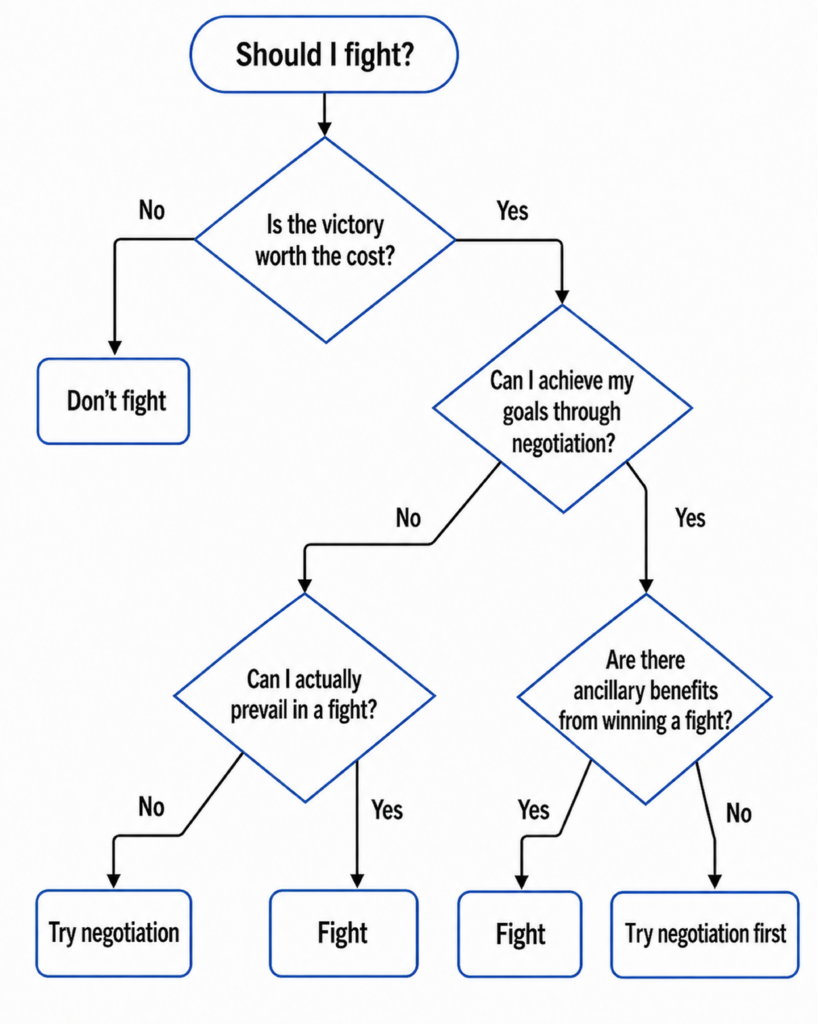
The initial question is whether victory is worth the cost (often described as whether the juice is worth the squeeze). In most family court cases there are actually two costs to consider: the tangible costs of the litigation expenses and the intangible costs of harm to a co-parenting relationship or relationship with one’s children and the hassle and stress of litigation.
An example of this is a potential alimony reduction consultation I had a few years ago. The ex-husband lived out-of-state and was in his mid-80’s. He had retired since alimony was last set and his income was substantially reduced. However, his annual alimony obligation was less than 2% of the amount of his liquid assets. Assuming even modest growth on his investments, he could easily pay this alimony for a few decades without it cutting into his lifestyle. I asked him whether he really wanted to spend his late 80’s coming to South Carolina for depositions, mediation, and court, and whether he wanted me hounding him to fill out documents for the case. He did not, so we did not file.
If the juice is worth the squeeze, the next question is whether the goals can be accomplished through negotiation. If they can, that should generally be the next step. Negotiation is less expensive and less stressful. An agreement provides certainty that contested litigation never does. When issues are not urgent, fighting is rarely the best first option.
However, there are times where fighting is still the better option. This is when there are ancillary benefits from picking and winning a fight. This situation most often occurs when the other side is habitually taking unreasonable or extreme positions or is otherwise intransigent. Here the goal is not only to win the fight but to essentially pummel the other party in the hope that future behavior is more reasonable. Sometimes folks need to be kicked by the mule (or get a second kick from the mule) to get their attention.
Assuming that one does not believe negotiation will be fruitful, the third question is whether one can actually achieve one’s goals through litigation. No sense starting a fight one cannot win. If one has goals that are not realistically achievable through contested litigation, then negotiation is the only rational option. This will typically require the client to give up something the other side could likely not obtain from the court. I have found cash to sometimes be a very effective way to achieve custody goals that could not be obtained from a judge. Almost every attorney has settled cases by “horse trading” with each party getting something they want but might not get from the court in return for giving up something they want less that the other side both wants more and might not get from the court.
As this flowchart demonstrates, there are definitely times when fighting is necessary. However, more decisions lead away from fighting. You might think you want a fighter. A lot of the time you are better off with a negotiator with trial skills. A client who hires attorneys based solely on an attorney’s willingness to fight is likely to end up in many unnecessary, expensive, and unwinnable fights.

(0) Comments